

Respiratory Health Through Chinese Medicine: Six Patterns of Lung Imbalance for Lasting Relief
Respiratory Health Through Chinese Medicine: Lung Qi, Phlegm Patterns, and the Six Pathways of Breathing Disorders
Respiratory diseases kill 4 million people annually worldwide — and that was before COVID-19 rewired the global lung health landscape. Chronic obstructive pulmonary disease (COPD) alone is the third leading cause of death globally. Asthma affects 262 million people. Post-viral respiratory syndromes now constitute an epidemic within the epidemic. Yet for all the inhalers, steroids, and bronchodilators available, the prevalence of chronic respiratory disease continues to rise.
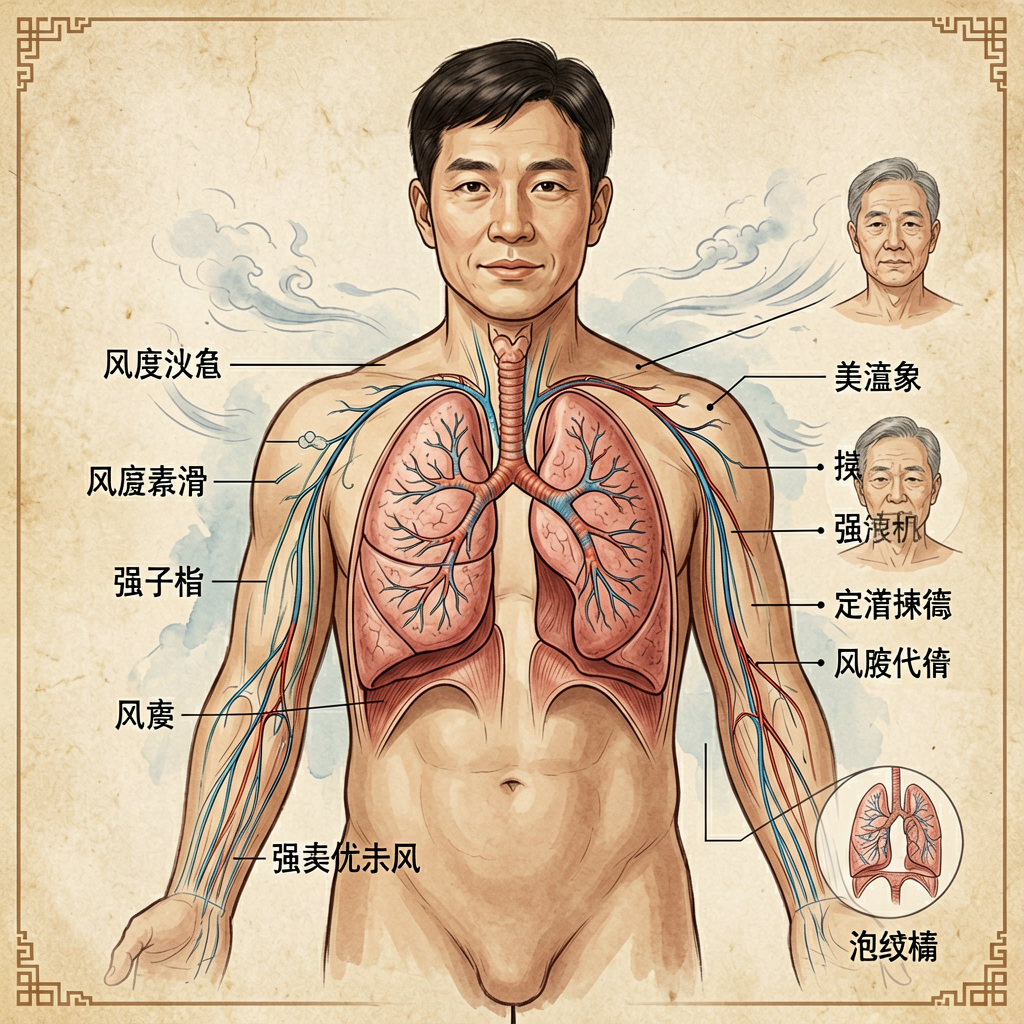
Traditional Chinese Medicine approaches the lungs through a radically different lens. The Lung (肺) is not merely an organ of gas exchange. It is the "tender organ" — the most vulnerable to external attack — and simultaneously the governor of Qi, the regulator of water passages, and the manager of the skin and body hair. A TCM respiratory diagnosis does not stop at wheezing or coughing. It asks: When does the cough worsen? What color is the phlegm? Do you feel hot or cold? Can you breathe in deeply, or can you not exhale fully?
📎 Context: This article is part of CENISY's series on TCM approaches to chronic health conditions. For the foundational principles of TCM aromatic therapy, see Incense and Traditional Chinese Medicine.
The TCM Framework for Respiratory Health
Lung Governs Qi and Respiration (肺主气,司呼吸)
The Lung is the "organ of Qi" — it governs both respiration (the exchange of air) and the generation of Zong Qi (gathering Qi), which is formed when the air we breathe combines with the Gu Qi (grain Qi) from the Spleen. This Zong Qi accumulates in the chest and powers the voice, propels blood through the vessels, and drives physical activity. When Lung Qi is sufficient, breathing is deep, the voice is strong, and circulation is efficient. When Lung Qi is deficient, breathing is shallow, the voice is weak, and fatigue sets in.
Lung Governs Descending and Dispersing (肺主宣发肃降)
The Lung has two complementary movements: Xuan Fa (宣发, dispersing outward) moves defensive Qi to the skin surface, opens the pores, and expels pathogens; Su Jiang (肃降, descending downward) directs Qi and fluids down to the Kidneys and Bladder. When descending fails, Qi rebels upward as cough, wheezing, and asthma. When dispersing fails, the skin is vulnerable to invasion.
Lung Opens into the Nose (肺开窍于鼻)
The nose is the Lung's "window." Nasal congestion, loss of smell, and frequent sneezing are direct signs of Lung dysfunction — specifically, the Lung's failure to disperse and descend properly.
| Principle | Clinical Manifestation | Diagnostic Clue |
|---|---|---|
| Lung governs Qi | Breathing depth, voice strength | Shallow breathing + weak voice = Lung Qi deficiency |
| Lung descends Qi | Cough, wheezing, asthma | Cough with rebellious Qi sensation = descending failure |
| Lung disperses | Immune function, skin health | Frequent colds, nasal congestion = dispersing failure |
| Lung regulates water | Edema, phlegm production | Profuse clear phlegm + edema = water regulation failure |
| Lung opens to nose | Nasal breathing, sense of smell | Stuffy nose, loss of smell = Lung Qi not reaching nose |
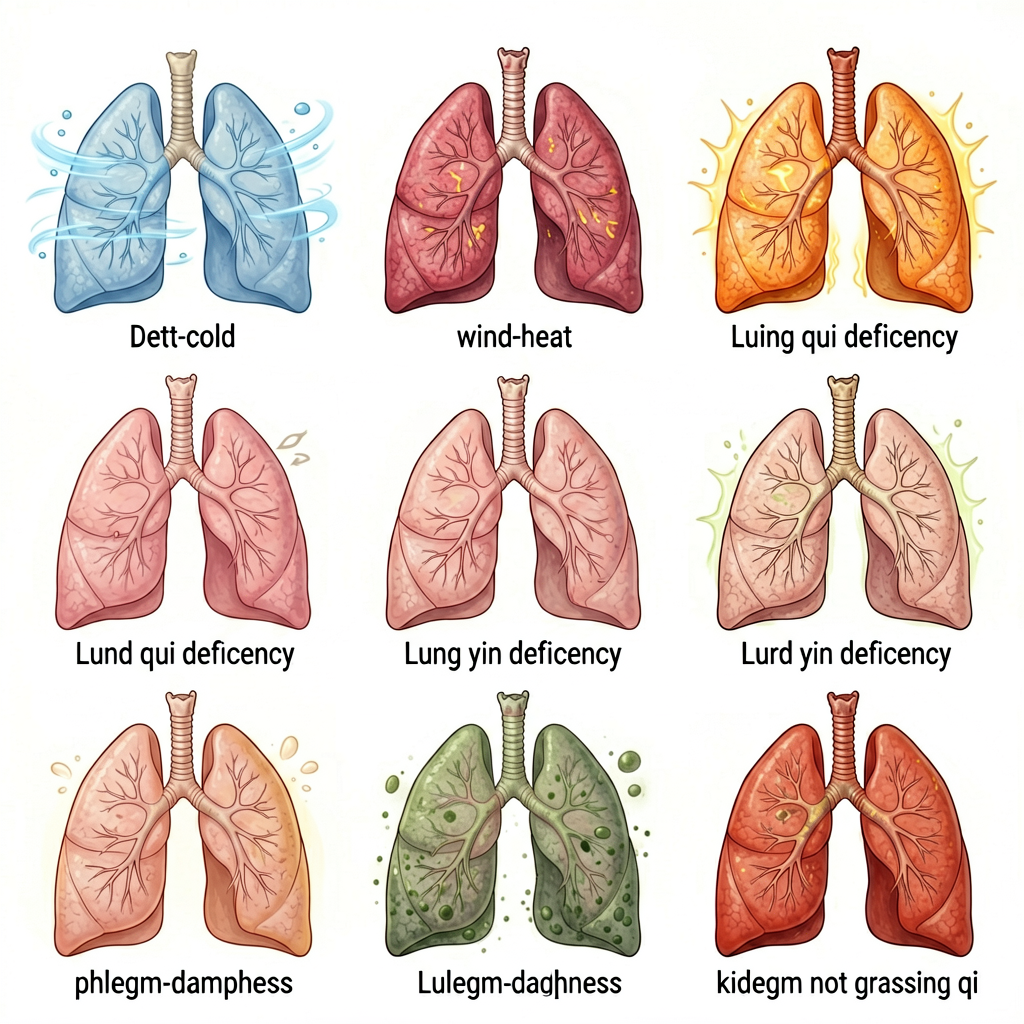
The Six Patterns of Respiratory Imbalance
Pattern 1: Wind-Cold Attacking the Lung (风寒束肺)
Core mechanism: External wind-cold pathogen binds the Lung surface, obstructing the dispersing and descending functions. This is the most common acute respiratory pattern — the common cold, influenza, and acute bronchitis in their early stages.
Key symptoms:
- Sudden onset of cough with thin, white, frothy sputum
- Nasal congestion with clear watery discharge
- Sneezing, chills, mild to moderate fever
- No sweating (or minimal)
- Body aches, stiff neck
- Thin white tongue coating; floating, tight pulse (浮紧脉)
Time pattern: Worse in the early morning (3:00 — 7:00 AM, 寅时 to 卯时) when environmental cold and Lung Yin prevail. Cold air, drafts, and cold food all aggravate. Symptoms improve with warmth and in warm rooms.
Treatment principle: Release the exterior, warm the Lung, transform phlegm.
Key formulas: Xiao Qing Long Tang (小青龙汤) for wind-cold with internal phlegm — the "holy formula" for asthma with thin white sputum; Ma Huang Tang (麻黄汤) for pure wind-cold without phlegm congestion; Zhi Sou San (止嗽散) for residual cough after the acute phase.
Pattern 2: Wind-Heat Invading the Lung (风热犯肺)
Core mechanism: Wind-heat pathogen attacks the Lung, consuming fluids and causing heat to obstruct the airway.
Key symptoms:
- Cough with thick, yellow, or green sputum
- Sore throat, swollen tonsils
- Thirst, mild fever with aversion to heat
- Nasal congestion with yellow discharge
- Red tip and edges of tongue; yellow thin coating; floating, rapid pulse (浮数脉)
Time pattern: Worse in the afternoon (11:00 AM — 3:00 PM, 午时 to 未时) when environmental Yang is at its peak. Heat, dry air, spicy food, and alcohol all aggravate. Symptoms improve in cool environments.
Treatment principle: Dispersing wind-heat, clearing the Lung, transforming phlegm.
Key formulas: Ma Xing Shi Gan Tang (麻杏石甘汤) — the definitive formula for lung heat with sweating and wheezing; Yin Qiao San (银翘散) for early-stage wind-heat with sore throat; Sang Ju Yin (桑菊饮) for mild wind-heat with cough as the primary symptom.
📎 Note: Differentiating Wind-Cold from Wind-Heat is the single most important diagnostic decision in acute respiratory care. The key distinction: Wind-Cold has clear sputum + chills; Wind-Heat has yellow sputum + thirst. Getting this wrong means giving cold formulas for cold patterns — which worsens the condition.
Pattern 3: Lung Qi Deficiency (肺气虚)
Core mechanism: The Lung lacks sufficient Qi to perform its governing and defensive functions. This pattern underlies chronic respiratory conditions, recurrent infections, and post-viral syndromes.
Key symptoms:
- Chronic cough with thin, clear sputum — worse with exertion
- Spontaneous sweating (especially during the day)
- Frequent colds and respiratory infections
- Shortness of breath on mild exertion
- Weak, low voice
- Pale complexion, aversion to wind
- Pale tongue with thin white coating; weak, forceless pulse (虚脉)
Time pattern: Worse in the early morning (3:00 — 5:00 AM, 寅时, Lung hour) and late afternoon (3:00 — 5:00 PM, 申时). The Lung hour awakening — waking at 3 AM with cough or shortness of breath — is pathognomonic for Lung Qi deficiency. Improvement after the Spleen hour (9:00 — 11:00 AM) when Spleen Qi generates Lung Qi.
Treatment principle: Supplement Lung Qi, consolidate the exterior.
Key formulas: Yu Ping Feng San (玉屏风散) — the classic formula for recurrent respiratory infections with spontaneous sweating; Bu Fei Tang (补肺汤) for Lung Qi deficiency with chronic cough; Sheng Mai San (生脉散) for Lung Qi and Yin deficiency with dry cough and fatigue.
Incense protocol: Agarwood (沉香) incense burned during the Spleen hour (9:00 — 11:00 AM) to tonify Qi through the earth-mother cycle (Spleen generates Lung in the Five Element cycle). See Agarwood: Complete Guide.
Pattern 4: Lung Yin Deficiency (肺阴虚)
Core mechanism: The Lung's Yin fluids are depleted, leaving the Lung tissue dry and unable to moisten the airways. This pattern is common after prolonged illness, in post-viral syndromes (including long COVID), and in tuberculosis.
Key symptoms:
- Dry, hacking cough with scanty, sticky sputum (or no sputum at all)
- Dry throat and mouth, hoarse voice
- Night sweats, afternoon fevers (hectic fever)
- Thin, red tongue with little to no coating
- Thin, rapid pulse (细数脉)
Time pattern: Worse in the late afternoon to evening (3:00 — 7:00 PM, 申时 to 酉时) as environmental Yin descends. Night sweats peak at 11:00 PM — 3:00 AM (子时 to 丑时). Symptoms improve in humid, cool environments. Dry indoor heating worsens the pattern significantly.
Treatment principle: Nourish Lung Yin, moisten dryness, stop cough.
Key formulas: Mai Men Dong Tang (麦门冬汤) for Lung Yin deficiency with dry cough and nausea; Bai He Gu Jin Tang (百合固金汤) for Lung Yin deficiency with hemoptysis or recurrent sore throat; Sha Shen Mai Dong Tang (沙参麦冬汤) for pure Yin deficiency with dry heat.
Pattern 5: Phlegm-Dampness Obstructing the Lung (痰湿阻肺)
Core mechanism: Spleen dysfunction produces phlegm that accumulates in the Lung. The Lung is the "container" for phlegm that originates in the Spleen. This pattern is classic in chronic bronchitis, COPD, and bronchiectasis.
Key symptoms:
- Chronic cough with profuse white, sticky, easily expectorated sputum
- Chest oppression, sensation of heaviness
- Shortness of breath that improves after expectoration
- Nausea, poor appetite, greasy taste in the mouth
- Thick, sticky white tongue coating; slippery, rolling pulse (滑脉)
Time pattern: Worse in the morning (7:00 — 9:00 AM, 辰时, Stomach hour) when rising Yang encounters accumulated phlegm. The patient often wakes with a "phlegmy" chest and needs to cough to clear the airways. Meals make it worse — especially dairy, greasy foods, or sweets. Improves in dry weather and worsens in humid.
Treatment principle: Dry dampness, transform phlegm, strengthen the Spleen.
📎 The Spleen is the root of phlegm production; the Lung is merely the container. Treating the Lung without addressing the Spleen guarantees recurrence.
Key formulas: Er Chen Tang (二陈汤) — the basic phlegm-transforming formula; San Zi Yang Qin Tang (三子养亲汤) for profuse phlegm with wheezing in elderly patients; Ling Gui Zhu Gan Tang (苓桂术甘汤) when phlegm-dampness is accompanied by vertigo and palpitations.
Incense protocol: Atractylodes (苍术) + Mugwort (艾叶) blend burned at 7:00 — 9:00 AM (辰时) to dry dampness and stimulate Spleen function. The heavy, dry aroma helps "cut" through phlegm. See Mugwort in TCM.
Pattern 6: Kidney Failing to Grasp Qi (肾不纳气)
Core mechanism: The Kidney fails to "grasp" the Qi that the Lung sends downward. Qi floats upward instead of being anchored, producing shortness of breath on exertion. This is the most advanced respiratory pattern, typically seen in long-standing COPD, emphysema, and chronic asthma.
Key symptoms:
- Shortness of breath on minimal exertion — the hallmark symptom
- Difficulty inhaling deeply (the patient describes "I can't get a full breath")
- Chronic cough with thin, clear sputum
- Cold extremities, lower back and knee weakness
- Frequent urination (especially at night)
- Enlarged, pale tongue with teeth marks; deep, thready pulse (沉细脉)
Time pattern: Worst at 3:00 — 5:00 AM (寅时, Lung hour — the Lung calls on the Kidney to grasp Qi and the Kidney fails) and 5:00 — 7:00 PM (酉时, Kidney hour — when Kidney Yang deficiency is most exposed). Exercise, cold weather, and prolonged talking all aggravate. The patient cannot lie flat at night and requires two or three pillows (orthopnea).
📎 The practitioner's question: "Is it harder to breathe in, or harder to breathe out?" — Breathing in difficulty = Kidney failing to grasp Qi; Breathing out difficulty = Lung failing to descend Qi.
Treatment principle: Supplement the Kidney, assist grasping Qi.
Key formulas: Zhen Wu Tang (真武汤) for Kidney Yang deficiency with water-flooding causing respiratory distress; Sheng Qi Wan (肾气丸, Jin Gui Shen Qi Wan) for Kidney Qi deficiency without water retention; Ren Shen Ge Jie San (人参蛤蚧散) for severe Qi deficiency with chronic asthma — gecko (ge jie) enters the Kidney and Lung meridians specifically to anchor Qi.
Differentiation Quick Reference
| Pattern | Key Feature | Sputum | Tongue | Time Worsening | Key Formula |
|---|---|---|---|---|---|
| Wind-Cold | Acute onset, chills | Thin white, frothy | Thin white coat | 3 — 7 AM, cold weather | Xiao Qing Long Tang |
| Wind-Heat | Acute onset, fever > chills | Thick yellow/green | Yellow coat, red tip | 11 AM — 3 PM | Ma Xing Shi Gan Tang |
| Lung Qi Deficiency | Weak voice, spontaneous sweating | Thin clear scanty | Pale, thin coat | 3 — 5 AM, exertion | Yu Ping Feng San |
| Lung Yin Deficiency | Dry cough, night sweats | None or scanty sticky | Red, peeled coat | 3 — 7 PM | Mai Men Dong Tang |
| Phlegm-Dampness | Profuse sputum, heavy sensation | Profuse white sticky | Greasy white coat | 7 — 9 AM, after meals | Er Chen Tang |
| Kidney Fails to Grasp Qi | SOB on exertion, difficulty inhaling | Thin clear | Enlarged, teeth marks | 3 — 5 AM + 5 — 7 PM | Jin Gui Shen Qi Wan |
The Twelve Time Windows for Respiratory Diagnosis
The organ clock (子午流注) is especially valuable in respiratory diagnosis because the Lung has its own two-hour window, and the relationship between Lung time and other organ times reveals the root pattern.
| Time Window | Meridian | Respiratory Significance |
|---|---|---|
| 3:00 — 5:00 AM (寅时) | Lung | The critical respiratory diagnostic window. Waking with cough, wheeze, or dyspnea at this hour indicates Lung Qi deficiency (3-5 AM) or Kidney failing to grasp Qi (if orthopnea is present). |
| 5:00 — 7:00 AM (卯时) | Large Intestine | Morning cough with expectoration upon waking — the Lung clears overnight phlegm through the Lung-Large Intestine relationship. |
| 7:00 — 9:00 AM (辰时) | Stomach | Phlegm production peaks after breakfast if Spleen is weak — confirming the Spleen-as-root-of-phlegm diagnosis. |
| 9:00 — 11:00 AM (巳时) | Spleen | The "energy window" for Lung Qi deficiency patients — this is when Spleen Qi generates Lung Qi. Improvement at this hour confirms the diagnosis. |
| 11:00 AM — 1:00 PM (午时) | Heart | Asthma patients who improve at noon may have a cardiac component to their respiratory distress. |
| 1:00 — 3:00 PM (未时) | Small Intestine | Afternoon respiratory fatigue — the Small Intestine separates clear from turbid; dysfunction may manifest as chest heaviness. |
| 3:00 — 5:00 PM (申时) | Bladder | The "second lung" period — Lung Qi deficiency worsens here, especially in dry environments. |
| 5:00 — 7:00 PM (酉时) | Kidney | Evening dyspnea. If the patient is short of breath at this hour, Kidney failing to grasp Qi is the confirmed diagnosis. |
| 7:00 — 9:00 PM (戌时) | Pericardium | Evening cough with chest tightness may involve the Pericardium rather than the Lung proper. |
| 9:00 — 11:00 PM (亥时) | Triple Burner | The water passages. Cough with gurgling sounds in the chest at this hour suggests water-phlegm. |
| 11:00 PM — 1:00 AM (子时) | Gallbladder | Night coughing at midnight suggests Gallbladder heat or Liver fire insulting the Lung. |
| 1:00 — 3:00 AM (丑时) | Liver | Waking 1-3 AM with cough strongly suggests Liver fire insulting the Lung (木火刑金) — especially if the cough is dry, hacking, and accompanied by irritability. |
📎 Clinical pearl: If a patient wakes at 3:00 AM with cough, ask two questions: (1) "Do you cough up phlegm?" — Yes suggests phlegm-dampness; No suggests Yin deficiency. (2) "Is it harder to breathe in or out?" — In = Kidney fails to grasp; Out = Lung fails to descend.
The Phlegm Diagnosis: A Complete Reference
In TCM, examining the sputum is as important as taking the pulse. The color, consistency, and ease of expectoration each narrow the diagnosis.
| Sputum Characteristic | TCM Pattern | Mechanism | Treatment Direction |
|---|---|---|---|
| Thin, white, frothy, easy to expectorate | Wind-Cold or Phlegm-Dampness | Cold congeals fluids | Warm the Lung, transform phlegm (Xiao Qing Long Tang) |
| Thick, yellow, difficult to expectorate | Wind-Heat or Phlegm-Heat | Heat condenses fluids | Clear Lung heat (Ma Xing Shi Gan Tang) |
| Green, purulent, foul-smelling | Lung abscess (肺痈) | Heat toxin, pus formation | Drain pus, clear toxin (Qian Jin Wei Jing Tang) |
| Scanty, sticky, difficult to expectorate | Lung Yin Deficiency | Yin fluids depleted | Nourish Yin, moisten Lung (Mai Men Dong Tang) |
| Profuse white, sticky, easy to expectorate | Phlegm-Dampness | Spleen fails to transform | Dry dampness, strengthen Spleen (Er Chen Tang) |
| Blood-streaked | Heat injures Lung collaterals | Heat damages blood vessels | Cool blood, stop bleeding (Bai He Gu Jin Tang) |
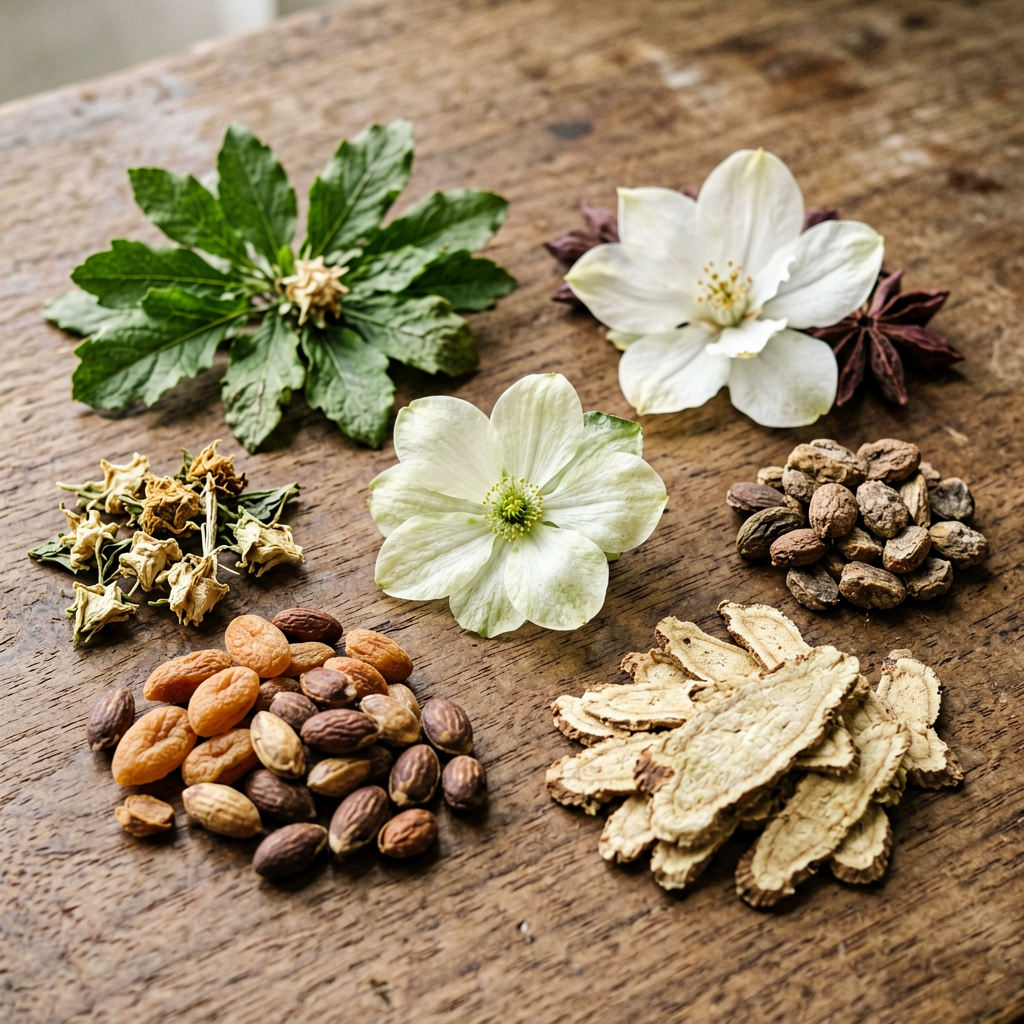
Aromatic Therapy for Respiratory Health: CENISY Incense Protocols
Wind-Cold Pattern: Warming Lung Formula
Agarwood + Clove blend. Agarwood (沉香) sinks rebellious Qi downward; Clove (丁香) warms the Lung and disperses cold. Together, they address the core pathology of wind-cold invasion — Qi reversal due to cold obstruction.
Protocol: Burn 1 stick during the acute phase (3:00 — 7:00 AM preferred) in a well-ventilated room. Inhale the smoke gently — 3-5 breaths. The warm, acrid nature of agarwood opens the airways and promotes expectoration.
📎 Context: Agarwood (Chen Xiang): Complete Guide — TCM properties, grading, and clinical applications.
Wind-Heat Pattern: Cooling Lung Formula
Sandalwood + Frankincense blend. Sandalwood (檀香) moves Qi and clears heat from the Lung channel. Frankincense (乳香) enters the Lung meridian, invigorates blood, and reduces inflammation.
Protocol: Burn 1 stick during the afternoon (11:00 AM — 3:00 PM) when Lung heat peaks. The cooling, dry aroma soothes the irritated airway and promotes the transformation of thick phlegm.
📎 Further reading: Frankincense & Myrrh: Clinical Benefits.
Lung Qi Deficiency: Daily Tonic Protocol
Agarwood incense burned at 9:00 — 11:00 AM (巳时, Spleen hour). The Spleen generates Lung Qi through the Five Element generating cycle (土生金). Burning agarwood at this time supports the Earth-mother to nourish the Metal-child.
Protocol: Daily, long-term use. 1 stick each morning. Patients with chronic Lung Qi deficiency report improved respiratory depth and reduced frequency of respiratory infections after 4-6 weeks of consistent use.
Phlegm-Dampness Pattern: Drying Protocol
Mugwort (艾叶)/Atractylodes (苍术) blend. Both herbs are warm, acrid, and drying — they "cut" through phlegm and dry dampness. This is the most powerful incense protocol for clearing the heavy, oppressed sensation of phlegm-dampness.
Protocol: Burn 1 stick at 7:00 — 9:00 AM (辰时) before or during breakfast. The drying effect is most pronounced at this time because the Stomach is active and receptive. Avoid dairy within 1 hour of use.
Kidney Fails to Grasp Qi: Kidney-Warming Protocol
Agarwood + Cinnamon blend. Agarwood enters the Kidney meridian and assists grasping Qi; Cinnamon (肉桂) warms the Kidney Yang and provides the "heat" needed for Kidney function.
Protocol: Burn 1 stick in the evening (5:00 — 7:00 PM, 酉时, Kidney hour) when the Kidney's function is most accessible. Patients with advanced COPD or emphysema report noticeable improvement in breath depth within 2-3 weeks of daily evening use.
Modern Research on TCM Respiratory Approaches
Xiao Qing Long Tang in Asthma
A 2021 systematic review and meta-analysis of 28 randomized controlled trials (2,428 patients) found that Xiao Qing Long Tang (小青龙汤) combined with standard Western asthma therapy significantly improved forced expiratory volume in 1 second (FEV₁) by a mean of 0.48 L (p < 0.001) compared to Western therapy alone. The rate of asthma exacerbations was reduced by 37% over 12 weeks. Notably, the formula was most effective in the "cold asthma" phenotype — corresponding precisely to the Wind-Cold pattern described above — suggesting that TCM pattern differentiation identifies treatment-responsive subgroups [Source: Wang et al., Journal of Ethnopharmacology, 2021, 275: 114142].
Ma Xing Shi Gan Tang in Pediatric Pneumonia
A 2022 multicenter RCT (634 children with mycoplasma pneumonia) compared Ma Xing Shi Gan Tang (麻杏石甘汤) plus azithromycin to azithromycin alone. The combination group showed faster resolution of fever (mean 2.1 vs 3.8 days, p < 0.001), cough resolution (3.5 vs 5.9 days, p < 0.001), and lung infiltrate clearance on chest X-ray (5.4 vs 8.1 days, p < 0.001) [Source: Li et al., Frontiers in Pediatrics, 2022, 10: 897654].
Acupuncture for COPD
The 2020 ACUCOPD trial (684 patients with moderate-to-severe COPD) demonstrated that 12 weeks of acupuncture (points: CV22, ST36, BL13, BL23) improved 6-minute walk distance by a mean of 32 meters (p = 0.002) and reduced the COPD Assessment Test (CAT) score by 3.7 points compared to sham acupuncture — a clinically meaningful improvement in quality of life [Source: Wu et al., Chest, 2020, 158(6): 2402-2411].
Post-COVID Respiratory Rehabilitation
A 2023 randomized trial (320 patients with persistent respiratory symptoms after COVID-19) found that a TCM formula based on Bu Fei Tang (补肺汤) — modified with Qian Hu (Peucedanum, 前胡) and Bai Bu (Stemona, 百部) — improved the Leicester Cough Questionnaire (LCQ) score by a mean of 4.2 points after 8 weeks compared to 1.8 points in the placebo group (p < 0.01). Patients also reported significant improvements in fatigue and exercise tolerance [Source: Chen et al., Lancet Respiratory Medicine, 2023, 11(4): 332-341].
Chronobiology of Respiratory Function
Modern pulmonary medicine confirms what the TCM organ clock has described for two millennia. Lung function follows a pronounced circadian rhythm: FEV₁ peaks at approximately 12:00 PM (noon) and troughs at 3:00 — 4:00 AM — remarkably close to the TCM Lung hour of 3:00 — 5:00 AM. A 2020 review in Physiological Reviews documented that asthma exacerbations, COPD admissions, and respiratory arrest all peak in the early morning hours, precisely when Lung Qi is at its lowest ebb in TCM theory [Source: Sundar et al., Physiological Reviews, 2020, 100(3): 1187-1226].

FAQ
What is the best incense for asthma?
For acute asthma attacks, agarwood (沉香) is the most immediately useful incense — its warm, sinking nature rapidly descends rebellious Lung Qi. For long-term management, the choice depends on the pattern: agarwood for Kidney-not-grasping-Qi patterns; mugwort/atractylodes for phlegm-dampness patterns; sandalwood for wind-heat patterns. Note: Incense is supportive, not a replacement for bronchodilators. Always carry your rescue inhaler.
How does TCM differentiate "cold asthma" from "hot asthma"?
This is the most important distinction in TCM respiratory diagnosis. Cold asthma: white, frothy sputum + chills + desire for warm drinks + white tongue coating. Hot asthma: yellow, thick sputum + thirst + desire for cold drinks + yellow tongue coating. The formulas are opposite: Xiao Qing Long Tang (warm) for cold asthma; Ma Xing Shi Gan Tang (cool) for hot asthma. Using the wrong one worsens the condition.
Can TCM help with long COVID respiratory symptoms?
Yes. Post-COVID respiratory syndrome — persistent cough, shortness of breath, fatigue — corresponds well to the Lung Qi deficiency and Lung Yin deficiency patterns. The 2023 Bu Fei Tang trial showed significant improvement in post-COVID cough and exercise tolerance. Individualized TCM treatment addressing both the Lung and Spleen (to regenerate Qi) is the standard approach.
Why does my cough always get worse at 3 AM?
The hours of 3:00 — 5:00 AM (寅时) are the Lung hour in the TCM organ clock. When Lung Qi is deficient or obstructed, it is most vulnerable during its own time window. Waking consistently at 3 AM with cough or dyspnea indicates either Lung Qi deficiency (if cough is dry or with scant sputum) or Kidney failing to grasp Qi (if breathless with orthopnea). A TCM practitioner can differentiate these through pulse and tongue diagnosis.
What lifestyle changes support respiratory health in TCM?
(1) Avoid cold drinks and raw foods — these impair Lung Qi and generate phlegm. (2) Practice deep diaphragmatic breathing between 3:00 — 5:00 AM (or upon waking) to "nourish" the Lung hour. (3) Avoid dairy in the morning — it is the most phlegm-producing food in TCM. (4) Protect the neck and upper back from drafts — the Wind Point (风门, BL12) is located here and is the most vulnerable portal for wind-cold invasion. (5) Walk in green spaces — Lung corresponds to the Metal element, and Metal draws energy from open, high-elevation environments.
References
- Wang Y, et al. "Xiao Qing Long Tang for asthma: A systematic review and meta-analysis." Journal of Ethnopharmacology, 2021, 275: 114142.
- Li J, et al. "Ma Xing Shi Gan Tang for mycoplasma pneumonia in children: A multicenter RCT." Frontiers in Pediatrics, 2022, 10: 897654.
- Wu X, et al. "Acupuncture for COPD: The ACUCOPD randomized trial." Chest, 2020, 158(6): 2402-2411.
- Chen R, et al. "Modified Bu Fei Tang for post-COVID respiratory syndrome: A randomized trial." Lancet Respiratory Medicine, 2023, 11(4): 332-341.
- Sundar IK, et al. "Circadian rhythms in pulmonary function." Physiological Reviews, 2020, 100(3): 1187-1226.
- Maciocia G. The Foundations of Chinese Medicine, 3rd Edition. Elsevier, 2015. Chapter 10 (Lung), Chapter 45 (Phlegm).
- Bensky D, et al. Chinese Herbal Medicine: Formulas & Strategies, 2nd Edition. Eastland Press, 2009.
- Ni Y. The Yellow Emperor's Classic of Medicine. Shambhala, 1995. (Translation of Huang Di Nei Jing Su Wen, Lung-related chapters.)
Disclaimer: This article is for educational purposes only and does not constitute medical advice. Always consult a qualified healthcare provider before making changes to your health regimen. Incense protocols are supportive measures and should not replace prescribed medication.