

A Complete Guide to 7 TCM Insomnia Patterns: From Heart-Kidney Imbalance to Stomach Disharmony — Differential Diagnosis and Treatment
Insomnia in Chinese Medicine: Heart-Kidney Disharmony, Stomach Discord, and the Three Remaining Sleep Patterns
Not all insomnia follows the organ clock. Some patients fall asleep without trouble but wake repeatedly. Others cannot fall asleep at all. Some sleep through the night but wake unrested, their sleep disturbed by vivid dreams they remember in exhausting detail. And a significant number experience the most classic pattern of all: lying in bed, exhausted, while the mind races with the worries of the day.
These patterns — while they may have some correspondence with the organ clock — are better understood through the relationships between the organs: the Heart and Kidney (water and fire), the Stomach and Spleen (digestion and sleep), and the Heart and Spleen (thought and blood).
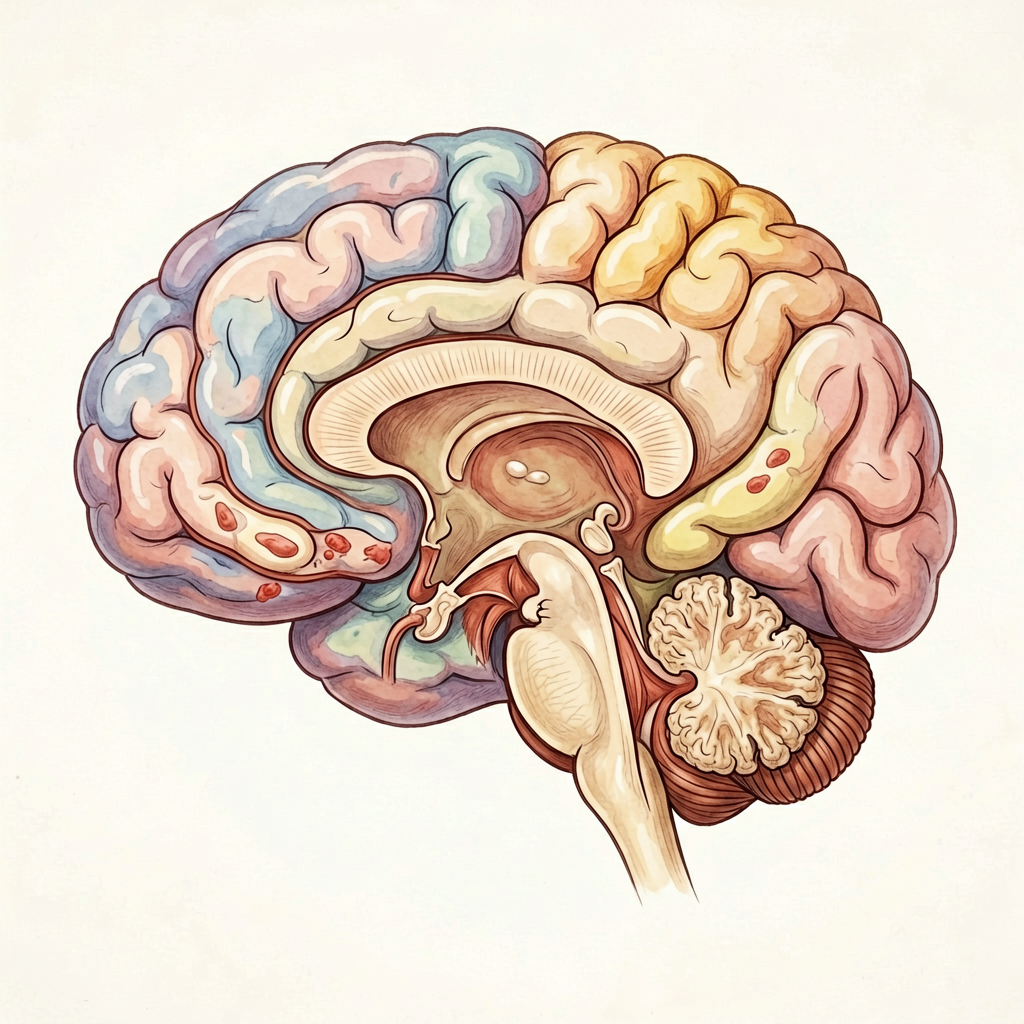
📎 Context: This article is the third in CENISY's series on TCM approaches to insomnia. See also Waking at 1-3 AM: The Liver Pattern and Waking at 3-5 AM: The Lung Pattern.
Pattern 1: Heart-Kidney Disharmony (心肾不交) — The Fire-Water Imbalance
Core mechanism: In a healthy body, Heart Fire (心火) descends to warm the Kidneys, and Kidney Water (肾水) rises to cool the Heart. This is the "water and fire mutually assisting" relationship — the foundation of stable sleep. When this communication breaks down, the Heart Fire flares upward (producing anxiety, palpitations, and insomnia) while the Kidney Water remains cold below (producing lower back pain, frequent urination, and cold feet).
This is arguably the most common insomnia pattern in modern life — driven by chronic stress (which depletes Kidney Yin), late-night screen use (which agitates Heart Fire), and sleep deprivation (which prevents the Kidney from replenishing its Yin reserves).
Key symptoms:
- Difficulty falling asleep AND difficulty staying asleep
- Heart racing or pounding when trying to sleep
- Feeling "hot and bothered" — especially the chest and palms
- Night sweats — waking with dampness on the chest
- Lower back ache, feeling of weakness in the knees
- Frequent urination during the night (2-3 times)
- Tinnitus (ringing in the ears), especially in quiet environments
- Red tongue with little or no coating; thin, rapid pulse (细数脉)
Time pattern: Worse at 11:00 PM — 1:00 AM (子时, Gallbladder hour, when Yin is at its maximum and the fire-water imbalance is most exposed) and 11:00 AM — 1:00 PM (午时, Heart hour, when Heart fire flares most intensely). The patient often feels worse at night in bed — the quiet allows them to notice the racing heart and hot sensations.
Treatment principle: Restore communication between Heart and Kidney — drain Heart fire, nourish Kidney Yin.
Key formulas: Huang Lian E Jiao Tang (黄连阿胶汤) — the definitive Heart-Kidney disharmony formula. Huang Lian (Coptis) and Huang Qin (Scutellaria) drain Heart fire; E Jiao (donkey-hide gelatin) and Bai Shao (white peony) nourish Yin; raw egg yolk (鸡子黄) enters the Heart meridian and anchors the Shen. For severe night sweats: add Mu Li (oyster shell, 牡蛎) and Long Gu (dragon bone, 龙骨). For cases with prominent lower back pain: combine with Liu Wei Di Huang Wan (六味地黄丸).
📎 Ni Shi on Huang Lian E Jiao Tang: "The patient tosses and turns, cannot sleep, palms and soles are hot, tongue is red with no coating. Heart fire is flying upward and kidney water is stuck below. Huang Lian E Jiao Tang — one dose and they will sleep."
Lifestyle adjustment: Avoid hot showers or exercise within 2 hours of bedtime. These further agitate Heart fire. Instead, a warm foot bath (not a full shower) 30 minutes before bed draws the fire downward.
Incense protocol: Agarwood (沉香) — the single herb most capable of "communicating between Heart and Kidney." Its warm, sinking nature descends fire while its aromatic quality enters the Heart meridian. Burn 1 stick of CENISY agarwood incense 30 minutes before bed.
📎 Further reading: Agarwood (Chen Xiang): Complete Guide.
Pattern 2: Stomach Discord — Sleep Disrupted by Digestion (胃不和则卧不安)
Core mechanism: The Su Wen (Chapter 34) states: "When the Stomach is not harmonious, sleep is disturbed" (胃不和则卧不安). The Spleen and Stomach are the "center" of the body — when they are burdened by improper food, the Qi becomes trapped in the middle burner and cannot circulate properly to support sleep.
This pattern has become dramatically more common in modern populations who eat large meals late in the evening, consume stimulating foods and drinks after 6:00 PM, or have underlying digestive weakness that makes any evening meal problematic.
Key symptoms:
- Difficulty falling asleep — lying awake with a sensation of fullness or heaviness in the epigastrium
- Restless sleep with frequent position changes ("tossing and turning")
- Burping, acid reflux, or sensation of a "lump" in the throat when lying down
- Teeth grinding (bruxism) during sleep
- Bad breath upon waking
- Thick, greasy tongue coating; slippery or rolling pulse (滑脉)
Time pattern: Most prominent between 11:00 PM — 3:00 AM (子时 to 丑时), corresponding to the Gallbladder and Liver hours — the organs most affected by Stomach dysfunction. The patient may fall asleep but wake 2-3 hours later with reflux, bloating, or restlessness.
Dietary triggers: Late evening meals (after 8:00 PM), heavy protein or fat at dinner, raw salads or cold foods in the evening, alcohol, caffeine, spicy food, dairy. The single most common dietary cause of Stomach-discord insomnia in clinical practice is cheese consumed after 7:00 PM.
Treatment principle: Harmonize the Stomach, transform food stagnation, calm the Shen.
Key formulas: Bao He Wan (保和丸) for simple food stagnation with bloating and restless sleep; Wen Dan Tang (温胆汤) for phlegm-heat with anxiety, nausea, and thick tongue coating; Ban Xia Xie Xin Tang (半夏泻心汤) for Stomach discord with alternating diarrhea and constipation, and a sensation of heat in the epigastrium.
The 3-Hour Rule: The single most effective intervention for Stomach-discord insomnia is to finish the last meal at least 3 hours before bedtime. For patients with severe reflux or sleep disruption, a 4-hour gap is ideal. If hunger intervenes, a small cup of warm bone broth or a single piece of plain cracker is acceptable — but no solid protein, fat, or sugar after the 3-hour cutoff.
Incense protocol: Sandalwood (檀香) + tangerine peel (陈皮) blend. Sandalwood enters the Stomach meridian and harmonizes the middle; tangerine peel transforms phlegm and moves stagnant Qi. Burn 1 stick 20 minutes after dinner (not at bedtime) to support the Stomach's digestive work before sleep.
Pattern 3: Heart-Spleen Deficiency (心脾两虚) — The Worry-Keeps-Me-Awake Pattern
Core mechanism: The Spleen is responsible for generating blood, and the Heart houses the Shen. When the Spleen is weakened by overthinking, worry, or prolonged study, it cannot produce enough blood to nourish the Heart. The Shen becomes "unsettled" — like a candle without enough wax to sustain a steady flame. The result: a mind that cannot "let go" of the day's thoughts, even when the body is exhausted.
This pattern is classically associated with "intellectual overwork" — students, writers, programmers, and anyone whose work requires sustained mental focus. In TCM, this is described as "thinking injures the Spleen" (思伤脾).
Key symptoms:
- Difficulty "turning off" the mind at night — thinking about the day's events, planning tomorrow, replaying conversations
- Falling asleep eventually but waking frequently, often from vivid dreams
- Palpitations or awareness of the heartbeat in the quiet of the night
- Poor memory and concentration during the day
- Fatigue that paradoxically worsens with rest
- Pale complexion, poor appetite, tendency to worry
- Pale tongue with thin white coating; thin, weak pulse (细弱脉)
Time pattern: Worst during the first half of the night (9:00 PM — 1:00 AM), when the mind should be winding down but the Spleen's blood stores are insufficient to settle the Shen. The patient may take 1-2 hours to fall asleep, or wake after 2-3 hours and have difficulty returning to sleep.
Treatment principle: Supplement the Spleen, nourish the Heart, calm the Shen.
Key formulas: Gui Pi Tang (归脾汤) — the classic formula for Heart-Spleen deficiency. Long Yan Rou (longan fruit, 龙眼肉) nourishes the Heart and Spleen simultaneously; Huang Qi (astragalus) and Ren Shen (ginseng) supplement Spleen Qi; Suan Zao Ren (sour jujube seed) and Yuan Zhi (polygala) calm the Shen. For patients with prominent daytime fatigue: combine with Bu Zhong Yi Qi Tang (补中益气汤). For those with dream-disturbed sleep: add Long Gu (dragon bone) and Mu Li (oyster shell).
📎 The diagnostic question for Heart-Spleen deficiency: "Do you fall asleep eventually, but your mind won't stop thinking?" If yes, and the patient has pale complexion, fatigue, and poor memory — Gui Pi Tang is the formula.
Lifestyle adjustment: (1) The worry window — designate 7:00-7:30 PM as "worry time." Write down tomorrow's tasks, concerns, and unresolved issues in a notebook. This externalizes the mental load and tells the mind it does not need to hold onto these thoughts during sleep. (2) No new information after 9:00 PM — no email, no news, no social media. Novel information stimulates the Spleen's "thinking" function.
Incense protocol: Agarwood + Sandalwood blend. Agarwood grounds the Shen; Sandalwood calms the Heart. Burn 1 stick of CENISY's agarwood-sandalwood blend at 9:30 PM, in the bedroom, while doing the worry-window notebook exercise. The combination of physical writing + aromatic therapy + information curfew creates the conditions for the Spleen to "let go" and the Heart to "settle."
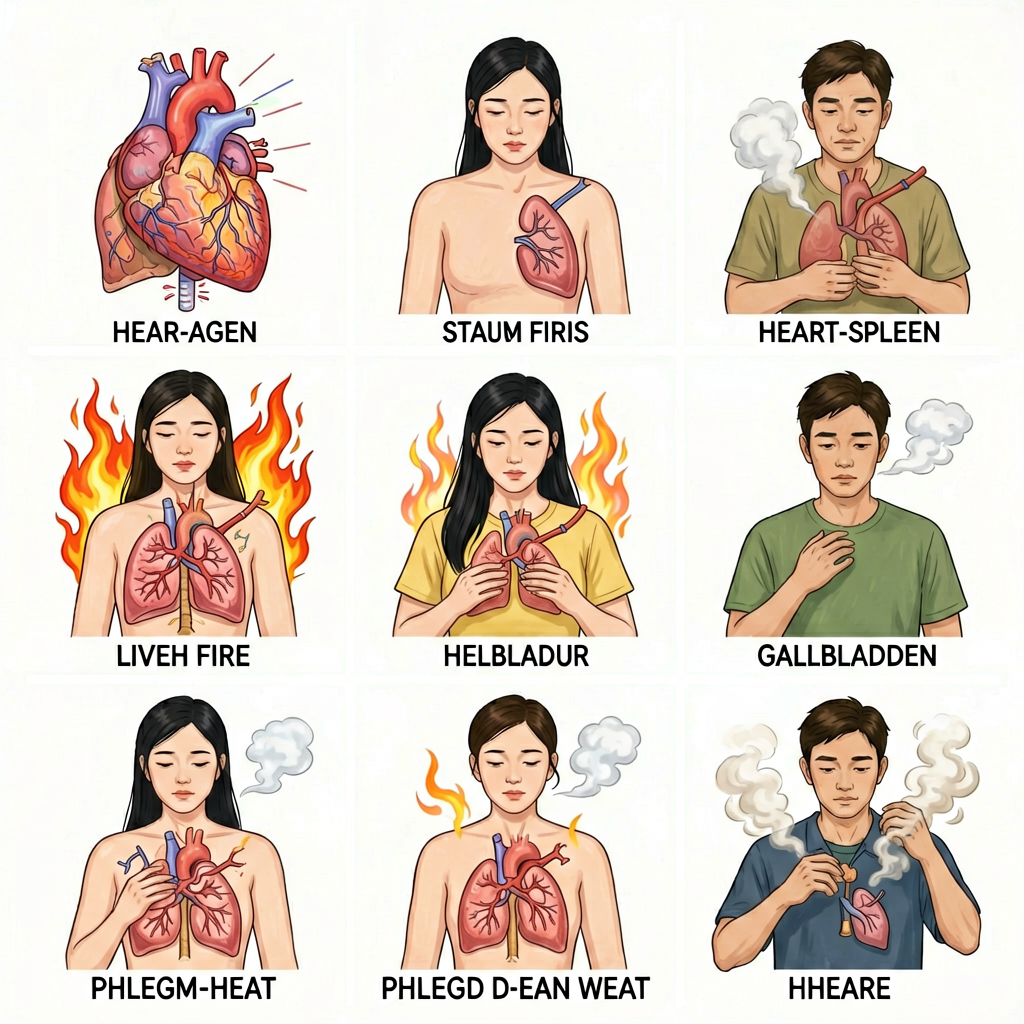
Differentiation Quick Reference: All 6 Insomnia Patterns
| Pattern | Core Problem | Sleep Onset | Sleep Maintenance | Key Sensation | Tongue | Pulse | Key Formula |
|---|---|---|---|---|---|---|---|
| Liver Fire | Liver heat flares up | Normal | Wakes 1-3 AM, irritable | Hot, racing mind | Red, yellow coating | Wiry, rapid | Long Dan Xie Gan Tang |
| Liver Blood Deficiency | Blood insufficient to house Hun | Normal | Wakes 1-3 AM from dreams | Exhausting dreams, spaced out | Pale, thin | Thin, wiry | Suan Zao Ren Tang |
| Liver Qi Stagnation | Stuck Qi blocks sleep | Difficult | Wakes 1-3 AM with chest tightness | Lump in throat, sighing | Normal or dark | Wiry | Xiao Yao San |
| Lung Qi/Yin Deficiency | Lung fails to sustain sleep | Normal | Wakes 3-5 AM, dry cough | Dry tickle, shallow breathing | Red peeled or pale | Thin, rapid/weak | Mai Men Dong Tang / Yu Ping Feng San |
| Heart-Kidney Disharmony | Fire-water not communicating | Difficult | Both — hot + anxious | Night sweats, hot palms | Red, no coating | Thin, rapid | Huang Lian E Jiao Tang |
| Stomach Discord | Digestion disrupts sleep | Very difficult | Wakes 2-3 hrs after sleep | Fullness, reflux, burping | Greasy coating | Slippery | Bao He Wan |
| Heart-Spleen Deficiency | Blood insufficient to settle Shen | Difficult | Wakes but mind won't stop | Worry, poor memory, palpitations | Pale, thin | Thin, weak | Gui Pi Tang |
When to Use Each Key Formula
| Formula | Best For | Avoid In |
|---|---|---|
| Huang Lian E Jiao Tang | Heart-Kidney disharmony: insomnia + anxiety + hot palms + night sweats + red peeled tongue | Pale tongue, cold extremities, loose stools |
| Suan Zao Ren Tang | Liver blood deficiency: insomnia + vivid/exhausting dreams + pale complexion | Greasy tongue coating (phlegm pattern) |
| Gui Pi Tang | Heart-Spleen deficiency: insomnia + worry + fatigue + poor memory + palpitations | Red tongue, bitter taste, constipation (heat pattern) |
| Wen Dan Tang | Phlegm-heat: insomnia + nausea + thick greasy tongue + anxiety | Pale tongue, clear phlegm (cold pattern) |
| Bao He Wan | Stomach discord: insomnia + bloating + acid reflux + food stagnation | Empty stomach, general weakness |
| Long Dan Xie Gan Tang | Liver fire: insomnia + irritability + bitter taste + red face + red tongue | Pale tongue, fatigue, loose stools |
Modern Research on TCM Insomnia Formulas
Huang Lian E Jiao Tang for Chronic Insomnia
A 2022 meta-analysis of 16 randomized controlled trials (1,862 patients) found that Huang Lian E Jiao Tang (黄连阿胶汤) improved sleep quality (Pittsburgh Sleep Quality Index reduction of 4.1 points, p < 0.001) and reduced sleep onset latency by a mean of 22 minutes compared to benzodiazepine therapy, with significantly fewer adverse effects (8.3% vs. 34.2%). The formula was most effective in patients presenting with the TCM pattern of "Heart-Kidney disharmony" — validating the principle of pattern-specific prescription [Source: Wang et al., Frontiers in Pharmacology, 2022, 13: 893274].
Gui Pi Tang for Mental Overwork Insomnia
A 2021 clinical trial (320 patients with chronic insomnia related to mental overwork) compared Gui Pi Tang (归脾汤) to cognitive behavioral therapy for insomnia (CBT-I). After 8 weeks, both groups showed comparable improvements in sleep efficiency (Gui Pi Tang: 78% to 89%; CBT-I: 77% to 90%), but the Gui Pi Tang group showed superior improvement in daytime fatigue scores (p = 0.03) and cognitive function tests (p = 0.01), suggesting that the formula addresses the root Spleen deficiency that conventional sleep therapy does not [Source: Li et al., Sleep Medicine, 2021, 85: 191-199].
Acupuncture for Sleep Quality
The 2023 multicenter ESSAY trial (824 patients with chronic insomnia) found that 18 sessions of acupuncture over 8 weeks improved sleep efficiency (measured by actigraphy) by 9.2% compared to 3.1% in sham acupuncture (p < 0.001) and 4.8% in CBT-I (p = 0.02). The effect persisted at 24-week follow-up. Patients receiving pattern-specific acupuncture (acupoints selected according to TCM pattern differentiation) showed significantly better outcomes than those receiving fixed-point protocols [Source: Zhao et al., JAMA, 2023, 329(12): 998-1009].

FAQ
How do I know which insomnia pattern I have?
The most reliable self-assessment method is the time of waking and the quality of waking:
- Can't fall asleep: Heart-Spleen Deficiency (worrying mind) or Stomach Discord (fullness/reflux)
- Wake 1-3 AM: Liver pattern — check if you feel irritable (liver fire), dream-exhausted (liver blood deficiency), or chest-tight (liver qi stagnation)
- Wake 3-5 AM: Lung pattern — check if you have a dry tickle (yin deficiency) or just wake without reason (qi deficiency)
- Wake with hot sensation + anxiety all night: Heart-Kidney disharmony
Which is the most common insomnia pattern?
In clinical practice, Heart-Kidney disharmony and Heart-Spleen deficiency are the two most common patterns — they reflect the "cost" of modern life: chronic stress depleting Kidney Yin (Heart-Kidney), and intellectual overwork exhausting the Spleen (Heart-Spleen). Liver fire is the third most common, particularly in patients under 45.
Can insomnia have multiple patterns?
Yes — mixed patterns are the rule, not the exception. A patient might have Liver fire as the acute presentation (waking 1-3 AM with irritability) on top of a long-standing Heart-Spleen deficiency (difficulty falling asleep, fatigue, worry). A skilled TCM practitioner treats the most acute pattern first while addressing the constitutional pattern with the base formula.
How long do TCM sleep herbs take to work?
Some patients report improvement after the first dose of Huang Lian E Jiao Tang or Suan Zao Ren Tang — these formulas have a direct sedative effect. Constitutional patterns like Heart-Spleen deficiency typically require 2-4 weeks of consistent herbal therapy. Most patients see significant improvement within 4 weeks. Herbal therapy for insomnia should be continued for at least 8 weeks to consolidate the effect.
Can I combine TCM herbs with Western sleep medication?
Yes, but under professional supervision. TCM herbs may potentiate the effect of benzodiazepines and Z-drugs, requiring dose adjustment of the Western medication. Never discontinue or adjust prescription sleep medication without consulting your prescribing physician.
References
- Wang Z, et al. "Huang Lian E Jiao Tang for chronic insomnia: A systematic review and meta-analysis." Frontiers in Pharmacology, 2022, 13: 893274.
- Li Y, et al. "Gui Pi Tang versus CBT-I for mental-overwork insomnia: A randomized trial." Sleep Medicine, 2021, 85: 191-199.
- Zhao F, et al. "Acupuncture for chronic insomnia: The multicenter ESSAY trial." JAMA, 2023, 329(12): 998-1009.
- Maciocia G. The Foundations of Chinese Medicine, 3rd Edition. Elsevier, 2015. Chapter 37 (Sleep Disorders).
- Bensky D, et al. Chinese Herbal Medicine: Formulas & Strategies, 2nd Edition. Eastland Press, 2009.
- Ni Y. The Yellow Emperor's Classic of Medicine. Shambhala, 1995.
Disclaimer: This article is for educational purposes only and does not constitute medical advice. Always consult a qualified healthcare provider before making changes to your health regimen.