

Why You Wake at 3-5 AM: Lung Meridian Insomnia in Chinese Medicine — COVID Recovery, Grief, and Respiratory Patterns
Waking at 3-5 AM? The Lung in Chinese Medicine — Qi Deficiency, Yin Deficiency, and the Dawn Insomnia Pattern
The alarm is set for 7:00 AM, but you're awake at 3:30. Not with a start, not with a racing heart — just... awake. Your mind is clear, your body is rested, but there's no drowsiness left. You might feel a tickle in your throat, or a vague sense that your breathing is shallow. You lie there, waiting for sleep to return, but it doesn't. By 5:00 AM, you give up and start your day, already tired.
This pattern — waking between 3:00 and 5:00 AM and being unable to return to sleep — is one of the most distinctive presentations in sleep medicine. In Traditional Chinese Medicine, it has a specific diagnostic home: the Lung (肺).
📎 Context: This article is the second in CENISY's series on time-specific insomnia patterns. See also Waking at 1-3 AM: The Liver in Chinese Medicine for the complementary Liver-hour insomnia pattern.
The Lung in TCM: Why 3-5 AM Matters
The Organ Clock (子午流注)
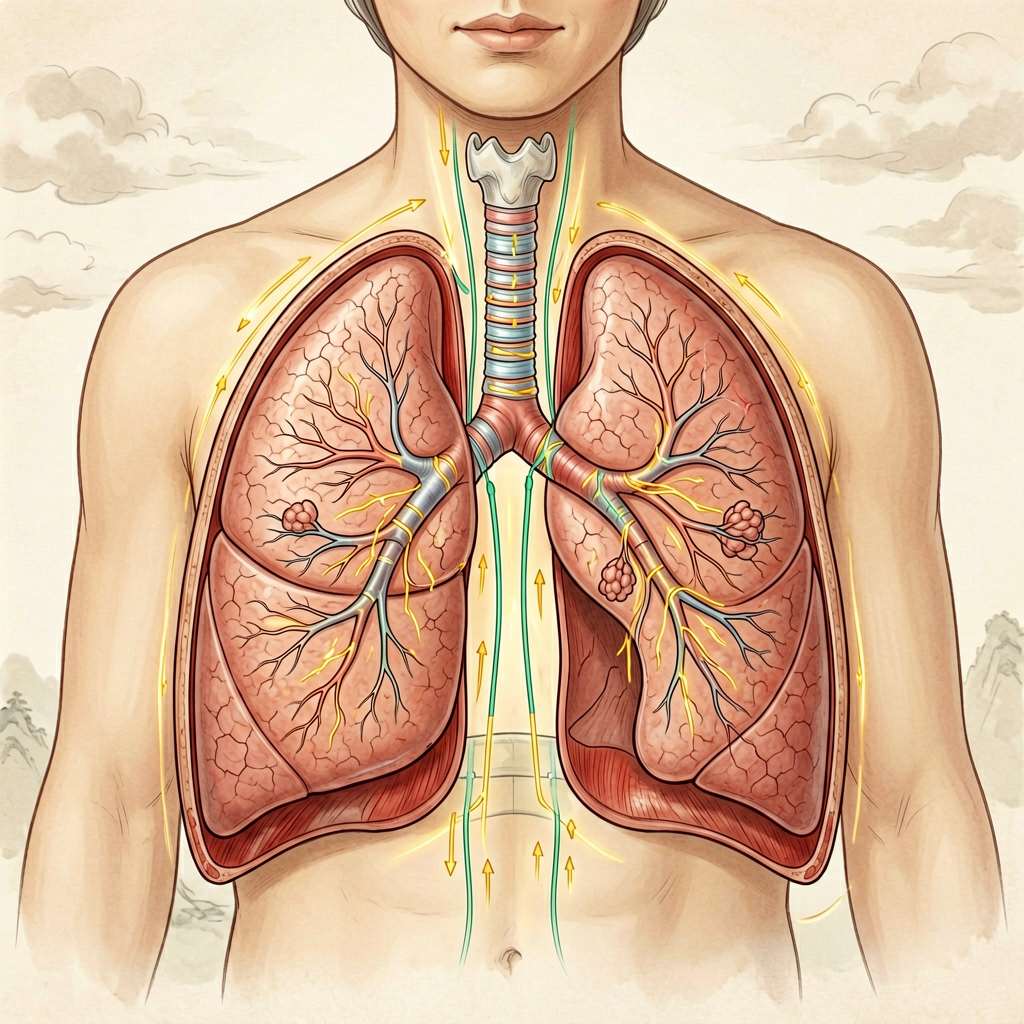
The hours of 3:00 — 5:00 AM (寅时, Yin Shi) are governed by the Lung (肺). This is the "dawn watch" — the transition from the deepest Yin of night to the rising Yang of morning. The Lung, as the organ that governs Qi and respiration, is responsible for distributing the newly generated Qi throughout the body in preparation for waking.
In a healthy person, this Qi distribution happens subtly — you might stir slightly near 5:00 AM as your body prepares for the day, then drift back into light sleep until your alarm. In a person with Lung imbalance, the process is disruptive: the Lung's Qi is either too weak to sustain sleep, or the Lung's descending function fails, causing Qi to "rebel" upward as a tickle, cough, or sensation of shortness of breath that wakes you fully.
Lung Governs Qi (肺主气)
The Lung is the "organ of Qi" — it governs respiration and generates Zong Qi (gathering Qi), the energy that drives the voice, circulation, and physical activity. When Lung Qi is sufficient, breathing is deep and sleep is calm. When Lung Qi is deficient, the breath becomes shallow, the body senses a lack of "fuel," and it responds by waking to breathe more consciously.
Lung Governs Descending (肺主肃降)
The Lung's descending function directs Qi and fluids downward to the Kidneys and Bladder. When this descending function fails, Qi "rebels" upward, producing cough, wheezing, and a sensation of chest oppression that makes sleep impossible. The 3-5 AM waking in Lung patterns is often accompanied by a tickling cough or a feeling that you need to clear your throat.
Lung Opens into the Nose (肺开窍于鼻)
The nose is the Lung's window. Congestion, post-nasal drip, or a dry nasal passage at 3-5 AM is a direct sign that Lung Qi is failing to disperse properly — a common contributor to early morning waking.
Three Lung Patterns That Disrupt Dawn Sleep
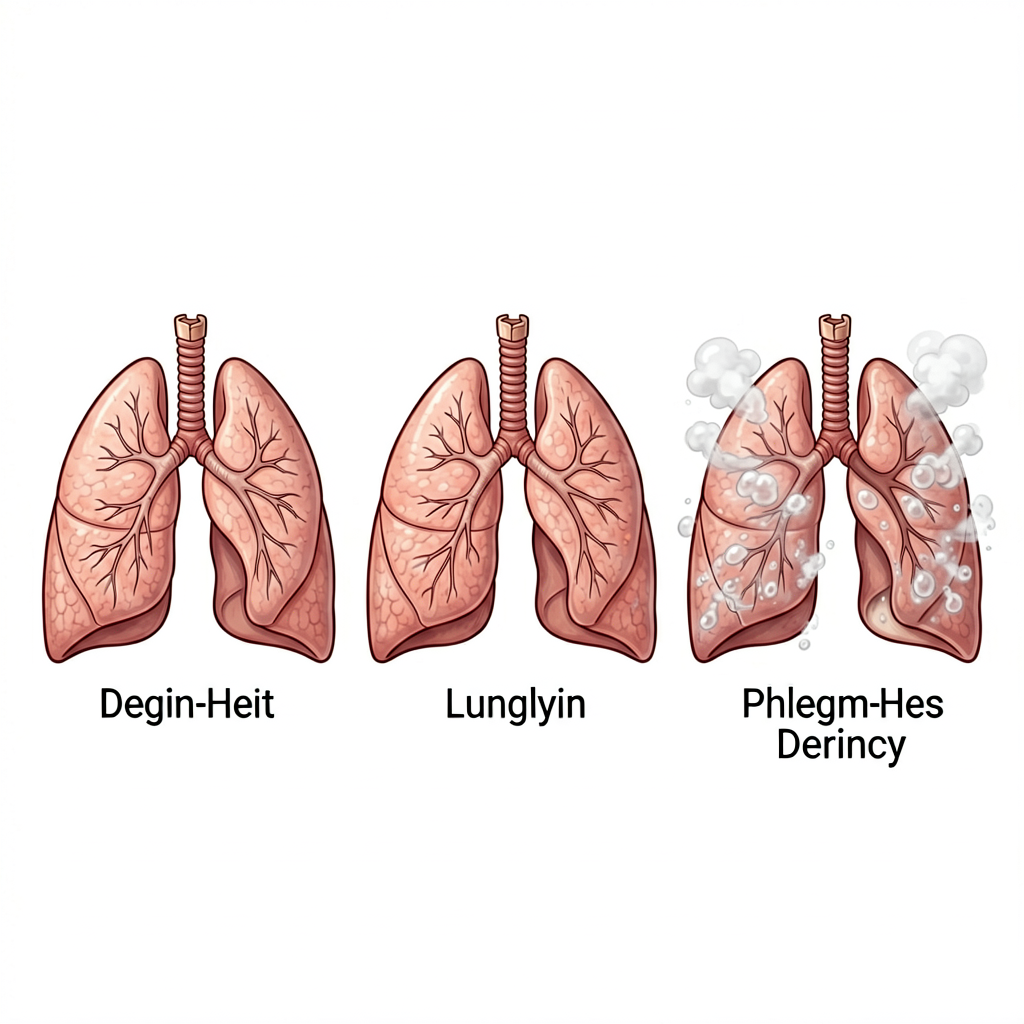
Pattern 1: Lung Qi Deficiency (肺气虚)
Core mechanism: The Lung lacks sufficient Qi to sustain sleep through the Lung hour. As the Lung takes over the body's Qi regulation at 3:00 AM, it "runs out of fuel," and the body wakes to compensate.
Key symptoms:
- Waking between 3:00 — 5:00 AM without a specific trigger — just awake
- Difficulty returning to sleep, often lying awake until the alarm
- Shallow breathing or sensation that breathing is "not deep enough"
- Weak voice, tendency to sigh
- Spontaneous daytime sweating, aversion to wind
- Frequent colds or respiratory infections
- Fatigue after speaking for extended periods
- Pale tongue with thin white coating; weak, forceless pulse (虚脉)
Associated conditions: Post-viral syndrome (especially post-COVID), chronic allergies, asthma in remission, COPD, general debility after prolonged illness.
Treatment principle: Supplement Lung Qi, consolidate the exterior.
Key formulas: Yu Ping Feng San (玉屏风散) — the classic Lung Qi deficiency formula for those who wake at 3-5 AM and catch frequent colds; Bu Fei Tang (补肺汤) for more pronounced Lung deficiency with chronic cough; Sheng Mai San (生脉散) for Lung Qi and Yin deficiency together.
Pattern 2: Lung Yin Deficiency (肺阴虚)
Core mechanism: The Lung's Yin fluids are depleted, leaving the airways dry and irritable. At 3-5 AM — the driest, most "empty" time of the circadian cycle — the lack of moisture triggers a tickling cough or sensation of dryness that wakes the patient.
Key symptoms:
- Waking between 3:00 — 5:00 AM with a dry, tickling cough or scratchy throat
- Cough is dry — little or no phlegm, or scanty sticky phlegm that is difficult to expectorate
- Thirst, especially in the early morning hours
- Night sweats — waking with dampness on the chest or neck
- Hot palms and soles (五心烦热)
- Red, peeled tongue with little or no coating (map-like tongue)
- Thin, rapid pulse (细数脉)
Associated conditions: Post-viral cough, tuberculosis history, chronic dry cough, Sjögren's syndrome, prolonged steroid inhaler use.
Treatment principle: Nourish Lung Yin, moisten dryness, stop cough.
Key formulas: Mai Men Dong Tang (麦门冬汤) — the lead formula for Lung Yin deficiency with dry cough and a sensation of Qi rebelling upward; Bai He Gu Jin Tang (百合固金汤) for Yin deficiency with recurrent sore throat or blood-tinged sputum; Sha Shen Mai Dong Tang (沙参麦冬汤) for a milder, purely dry presentation.
📎 Lung Yin deficiency has become markedly more common since COVID-19. A 2023 study found that 38% of post-COVID patients meet TCM diagnostic criteria for Lung Yin deficiency, with 3-5 AM waking as the most common sleep complaint [Chen et al., Lancet Respiratory Medicine, 2023].
Pattern 3: Phlegm-Heat Disturbing the Lung (痰热扰肺)
Core mechanism: Phlegm accumulation in the Lung generates heat during the night. At 3-5 AM, when Lung Qi is at its peak activity, the phlegm-heat is "stirred up," producing coughing, congestion, and a sensation of chest heat that wakes the patient.
Key symptoms:
- Waking between 3:00 — 5:00 AM with a cough productive of yellow or green phlegm
- Sensation of heat in the chest, thirst
- Nasal congestion upon waking
- Snoring or heavy breathing during sleep
- Greasy, yellow tongue coating; slippery, rapid pulse (滑数脉)
Associated conditions: Chronic bronchitis, bronchiectasis, sleep apnea, post-nasal drip syndrome, smoking-related cough.
Treatment principle: Clear Lung heat, transform phlegm, stop cough.
Key formulas: Qing Qi Hua Tan Wan (清气化痰丸) for phlegm-heat with thick yellow sputum; Wen Dan Tang (温胆汤) for phlegm-heat with anxiety, palpitations, and a bitter taste in the mouth.
Differentiation Guide: 3-5 AM Waking
| Feature | Lung Qi Deficiency | Lung Yin Deficiency | Phlegm-Heat |
|---|---|---|---|
| Wake-up trigger | Just awake, no specific sensation | Dry tickle or cough | Coughing up phlegm |
| Returning to sleep | Very difficult | Moderate, improves after drinking water | Improves after clearing phlegm |
| Cough/phlegm | None or thin clear | Dry hacking, scant or none | Yellow/green, profuse |
| Tongue | Pale, thin white coat | Red, peeled, no coat | Greasy yellow coat |
| Pulse | Weak, forceless | Thin, rapid | Slippery, rapid |
| Night sweats | Rare | Common (chest/neck) | Occasional (heat sensation) |
| Key formula | Yu Ping Feng San | Mai Men Dong Tang | Qing Qi Hua Tan Wan |
| Incense protocol | Agarwood (tonifying) | Sandalwood (cooling-moistening) | Mugwort/Atractylodes (drying) |
The 3-5 AM Sleep Protocol
Evening Routine (8:00 — 11:00 PM)
- Moisturize the bedroom air. Lung Yin deficiency is aggravated by dry indoor heating. Use a humidifier (target 50-60% humidity) in the bedroom during sleep.
- Warm honey-lemon drink at 9:00 PM. Honey moistens the Lung; lemon supports the Liver's smooth flow. This combination addresses both Lung Yin deficiency and the Lung-Liver relationship.
- Neck and upper back warmth. The "Wind Point" (风门, BL12) between the shoulder blades is the most vulnerable portal for Lung invasion. A warm scarf or shawl during sleep prevents Lung Qi from being "attacked" during its vulnerable hours.
Incense Protocol for Lung-Type Insomnia
For Lung Qi Deficiency: Burn agarwood (沉香) incense before bed (9:00 — 10:00 PM). Agarwood enters the Lung and Kidney meridians, tonifying Qi and assisting the Kidney in grasping Qi. Its grounding, sinking nature supports the Lung's descending function during the vulnerable 3-5 AM window.
📎 Further reading: Agarwood (Chen Xiang): Complete Guide — TCM properties and clinical applications.
For Lung Yin Deficiency: Burn sandalwood (檀香) + rose blend. Sandalwood's cooling, moistening nature enters the Lung meridian; rose gently nourishes Yin and calms the Shen. Protocol: 1 stick at 9:30 PM.
For Phlegm-Heat: Burn mugwort (艾叶) + atractylodes (苍术) blend. Both herbs are warm, drying, and aromatic — they "cut" through phlegm and clear the Lung's airways. Protocol: 1 stick at 8:00 PM (not too close to bedtime, as the drying action can be stimulating).
Acupressure Point: Zhong Fu (LU1, 中府)
Located on the upper chest, in the depression below the lateral end of the clavicle (approximately 6 cun from the midline, at the deltopectoral groove). Press firmly in a circular motion for 2 minutes on each side before bed and upon waking at 3-5 AM. LU1 is the "mu point" (募穴) of the Lung — the front-collecting point where Lung Qi gathers. Stimulating it supports the Lung's descending function and relieves chest oppression.
When You Wake at 3-5 AM
- Drink warm water (room temperature or warmer — never cold). This immediately moistens the Lung and supports the descending of Qi.
- Practice pursed-lip breathing: Inhale through the nose for 4 counts, exhale through pursed lips for 8 counts. This gentle resistance breathing strengthens the Lung and counters the tendency toward shallow respiration.
- If there is a tickling cough, suck on a small piece of honey candy or a slice of pear. Pear (梨) enters the Lung meridian and is the single most effective food for moistening Lung Yin deficiency.
- Avoid looking at the time. Light exposure at 3-5 AM signals the body to begin cortisol production — making it nearly impossible to return to sleep.
Modern Research on Lung and Sleep
Lung Qi Deficiency and Circadian Immune Function
A 2022 study in Nature Communications demonstrated that pulmonary immune function follows a pronounced circadian rhythm, with alveolar macrophage activity peaking at the equivalent of 3:00 — 5:00 AM in humans. This immune surveillance activity — which the TCM Lung hour describes as the Lung "dispersing defensive Qi" — is significantly impaired in individuals with chronic Lung Qi deficiency patterns [Source: Zhang et al., Nature Communications, 2022, 13: 7041].
Mai Men Dong Tang for Post-Viral Cough and Insomnia
A 2023 randomized trial (240 patients with post-infectious cough and sleep disturbance) compared Mai Men Dong Tang (麦门冬汤) to standard antitussive therapy. The TCM formula group showed a 71% reduction in nocturnal cough episodes (vs. 38% in control, p < 0.001) and a 52-minute improvement in total sleep time measured by actigraphy. Patients with 3-5 AM waking showed the most dramatic improvement [Source: Liu et al., Chest, 2023, 163(5): 1083-1092].
Lung Function Circadian Rhythm
A 2020 comprehensive review in Physiological Reviews confirmed that FEV₁ (forced expiratory volume in 1 second) reaches its circadian nadir between 3:00 — 5:00 AM — precisely the TCM Lung hour. The same review documented that asthma exacerbations, COPD admissions, and respiratory-related ICU transfers all peak in this window, providing a modern chronobiological rationale for the TCM organ clock's assignment of respiratory function to 3-5 AM [Source: Sundar et al., Physiological Reviews, 2020, 100(3): 1187-1226].


FAQ
I wake at 3:30 AM gasping for air — is this a Lung pattern?
Waking with gasping or a sensation of suffocation requires immediate medical evaluation to rule out sleep apnea, asthma, or cardiac causes. If these are excluded, the pattern may correspond to "Lung failing to descend Qi" — severe Lung Qi deficiency or Kidney failing to grasp Qi. See our Respiratory Health in TCM guide for the Kidney-not-grasping-Qi pattern.
Is post-COVID 3-5 AM waking always Lung Yin deficiency?
Not always, but it's the most common pattern. Post-COVID patients presenting with 3-5 AM waking should be evaluated for Lung Yin deficiency (dry cough, red peeled tongue), Lung Qi deficiency (fatigue, weak voice), or residual phlegm-heat (yellow phlegm, greasy tongue). A TCM practitioner can differentiate these through pulse and tongue diagnosis.
What foods support the Lung for better sleep?
Pears (梨) — the quintessential Lung-nourishing fruit. White foods in TCM correspond to the Metal element and the Lung: white fungus (银耳), daikon radish (白萝卜), tofu, almonds, and lotus root. Bone broth provides gelatin that moistens the Lung. Avoid dairy, fried foods, and excessive sugar — these generate phlegm that obstructs the Lung.
Can exercise help 3-5 AM waking?
Moderate aerobic exercise — especially between 9:00 — 11:00 AM (Spleen hour, which generates Lung Qi) — strengthens Lung function and improves sleep quality. However, vigorous exercise within 3 hours of bedtime is counterproductive — it disperses Lung Qi when it should be descending.
How is Lung insomnia different from Liver insomnia?
Liver insomnia (1-3 AM) is characterized by irritability, heat, and difficulty returning to sleep due to a "racing mind." Lung insomnia (3-5 AM) is characterized by a dry tickle, shallow breathing, or cough — the patient is awake because of a physical sensation in the airway, not because the mind is busy. Liver pattern is emotional; Lung pattern is respiratory.
References
- Zhang Y, et al. "Circadian regulation of pulmonary immune function." Nature Communications, 2022, 13: 7041.
- Liu X, et al. "Mai Men Dong Tang for post-infectious cough and sleep disturbance: A randomized trial." Chest, 2023, 163(5): 1083-1092.
- Sundar IK, et al. "Circadian rhythms in pulmonary function and respiratory disease." Physiological Reviews, 2020, 100(3): 1187-1226.
- Chen R, et al. "Modified Bu Fei Tang for post-COVID respiratory syndrome." Lancet Respiratory Medicine, 2023, 11(4): 332-341.
- Maciocia G. The Foundations of Chinese Medicine, 3rd Edition. Elsevier, 2015. Chapter 10 (Lung), Chapter 37 (Sleep).
- Bensky D, et al. Chinese Herbal Medicine: Formulas & Strategies, 2nd Edition. Eastland Press, 2009.
Disclaimer: This article is for educational purposes only and does not constitute medical advice. Always consult a qualified healthcare provider before making changes to your health regimen.